
PLCs and MTSS are not competing systems. They are two parts of one system, connected by a handoff. When the handoff is unclear, students can get lost between them.
Many schools have both.
Teacher teams meet in PLCs to look at student learning. An MTSS team, often called an RTI (Response to Intervention) team, meets to decide which students need additional support and what kind.
Both teams look at data. Both care about the same students.
But in many schools, no one has said clearly where one team's work ends and the other's begins.
When that line is unclear, two things tend to happen.
The PLC turns into a sorting meeting. Teachers spend the time reading through student names and deciding who should go to intervention. The question of what the team's own instruction should change never comes up.
And students get sent to intervention when the problem is core instruction. If many students across several classrooms miss the same skill, adding their names to an intervention list treats a classroom problem as an individual one.
The answer is not to merge the two teams. It is to define the handoff between them.
In brief
- The PLC examines learning across its classrooms and decides how its instruction should respond.
- The school's MTSS process coordinates additional support when a student's needs go beyond what core instruction and classroom reteaching can address.
- Before building intervention groups, a PLC should ask whether the evidence points to core instruction first.
- The handoff should carry evidence in both directions, not just student names.
On this page
- Three layers of support
- How the Short Data Cycle connects the PLC to MTSS
- Three questions that route the decision
- What the handoff should carry
- What this looks like in an elementary school
- What this looks like in a secondary school
- What leaders need to put in place
Three Layers of Support
MTSS is a schoolwide framework, not just the name of a team. It includes core instruction for every student, supplemental intervention for some, and intensive intervention for a few.
The MTSS Center describes the three tiers this way:
- Tier 1 is high-quality, schoolwide programming and supports designed to meet the needs of all students. Teachers use differentiation so all students can access core programming.
- Tier 2 is small-group, standardized interventions that have demonstrated positive effects.
- Tier 3 is intensive intervention, intensified and individualized based on student need.
Inside that framework, a PLC and an MTSS team do different kinds of work. Here is one way to divide it. Your school's structure may differ.
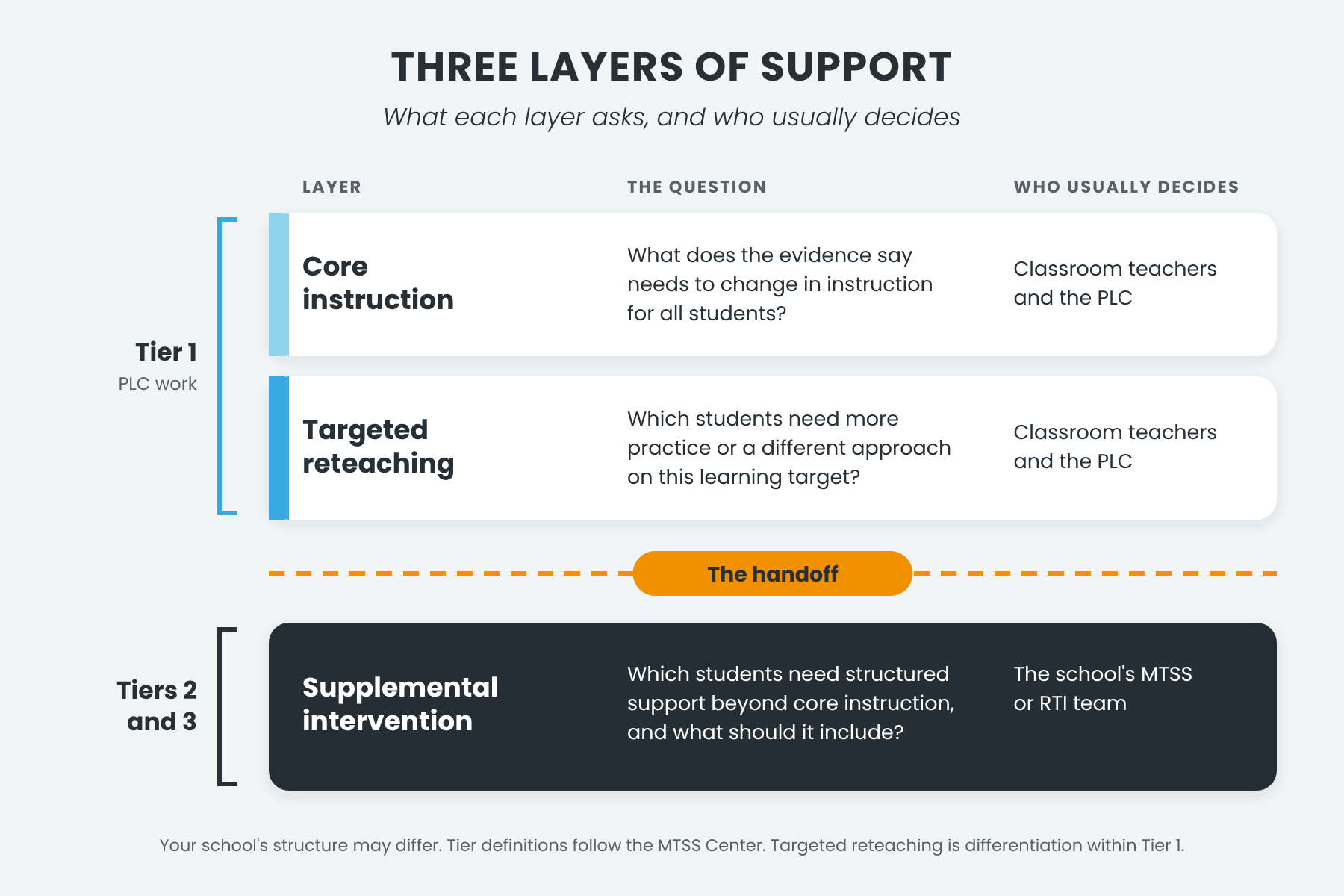
| Layer | The question | Who usually decides |
|---|---|---|
| Core instruction | What does the evidence say needs to change in instruction for all students? | Classroom teachers and the PLC |
| Targeted reteaching | Which students need more practice or a different approach on this learning target? | Classroom teachers and the PLC |
| Supplemental intervention | Which students need structured support beyond core instruction, and what should it include? | The school's designated MTSS or RTI team, following local procedures |
Targeted reteaching sits inside Tier 1. It is the differentiation that core instruction includes.
A note on the term "Tier 2 instruction"
The VOYAGE Horizons Short Data Cycle uses the label Tier 2 instruction for the targeted reteaching a PLC plans after a common assessment.
That label is part of the training routine. It is not the same as Tier 2 supplemental intervention in a district's MTSS framework.
To keep the two clear, this article uses targeted reteaching for the PLC's work and supplemental intervention for what the MTSS team decides.
Whatever terms your school uses, agree on where the line sits between targeted reteaching and supplemental intervention, and who decides when a student needs more.
How the Short Data Cycle Connects the PLC to MTSS
The Short Data Cycle is a routine for moving from formative data to an instructional decision inside a PLC meeting. It is organized around what happens before, during, and after the meeting.
The order of the steps is what keeps a PLC from becoming a sorting meeting.
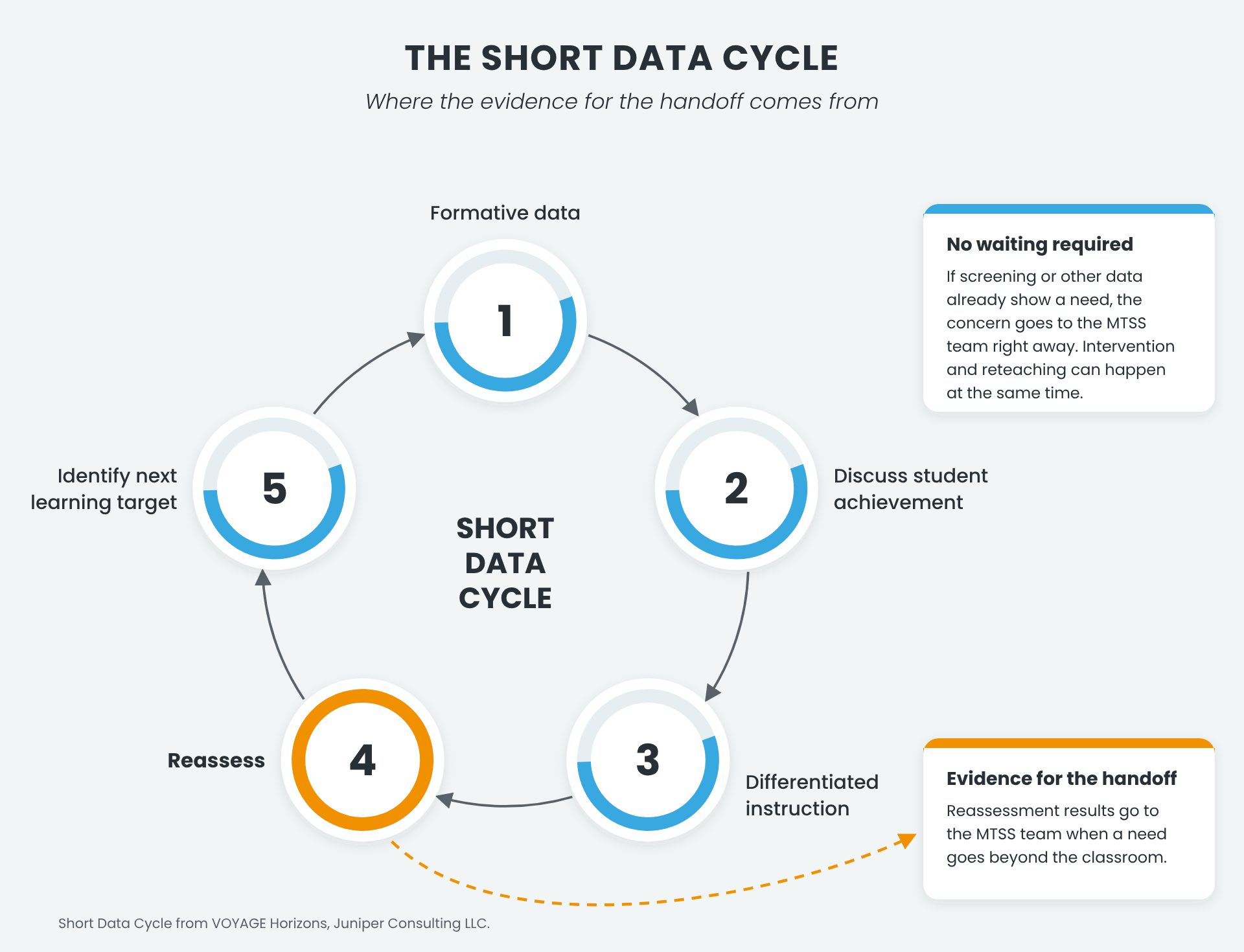
Before the meeting
- Each teacher reviews their own data using I Notice / I Wonder.
- Each teacher reflects on whether the curriculum and materials best supported effective Tier 1 instruction.
During the meeting
- The team holds a whole-group data discussion first.
- Then it creates action steps for intervention and enrichment.
- It connects those plans to the instructional standard and learning target, and identifies, discusses, or reviews the common assessment.
After the meeting
- Teachers reteach by putting the action steps into instruction.
- They reassess the targeted reteaching, which the routine calls "Tier 2 instruction," based on those action steps.
- They teach the next standard and give the next common assessment.
Notice what comes first. The question about core instruction is asked before anyone builds a group.
Notice what comes last. The reassessment produces evidence about whether the reteach worked.
That reassessment is one valuable source of evidence for the handoff. When a PLC raises a concern with the MTSS team, it can send more than a name. It can send evidence.
The handoff does not have to wait
A PLC does not need to complete a reteaching cycle before raising a concern with the MTSS team.
If screening data, existing progress-monitoring results, or other evidence already show that a student needs additional support, the concern should go to the MTSS team right away.
The two processes can also run at the same time. A student can receive supplemental intervention while the classroom teacher continues to adjust instruction and reteach in class.
For a closer look at the routine itself, see Decision Making with the Short Data Cycle and From Data to Decisions.
Three Questions That Route the Decision
When a PLC looks at a common assessment, three questions help it decide where the next step belongs.
1. Did many students miss it, across several classrooms?
That pattern points to core instruction first.
The team looks at how the target was taught, what materials were used, and what the student work shows about the misunderstanding. The response is a change to instruction for everyone, not a longer intervention list.
2. Did some students miss it?
That points to targeted reteaching.
The team plans a short reteach for those students, agrees on how it will check, and reassesses within the cycle.
3. Does the evidence suggest a need beyond what the classroom can address?
That points to the MTSS team.
Several kinds of evidence can raise this question:
- A pattern. The same students miss target after target, even with reteaching.
- Depth. The student seems to be missing a skill that sits underneath the current target, and a short reteach of today's lesson cannot reach it.
- Existing data. Screening or progress-monitoring results already show a significant need.
When any of these appear, the PLC shares the concern and its evidence with the MTSS team.
These questions are a routine, not a formula. They do not replace your district's MTSS decision rules, and they are not a gate a student must pass through before getting support. They help a PLC decide whether a concern belongs to the team's instruction, needs to go to the MTSS team, or both.
What the Handoff Should Carry
A referral that says "Jordan is struggling in math" gives the MTSS team very little to work with.
The handoff works best when both teams know what to expect from each other.
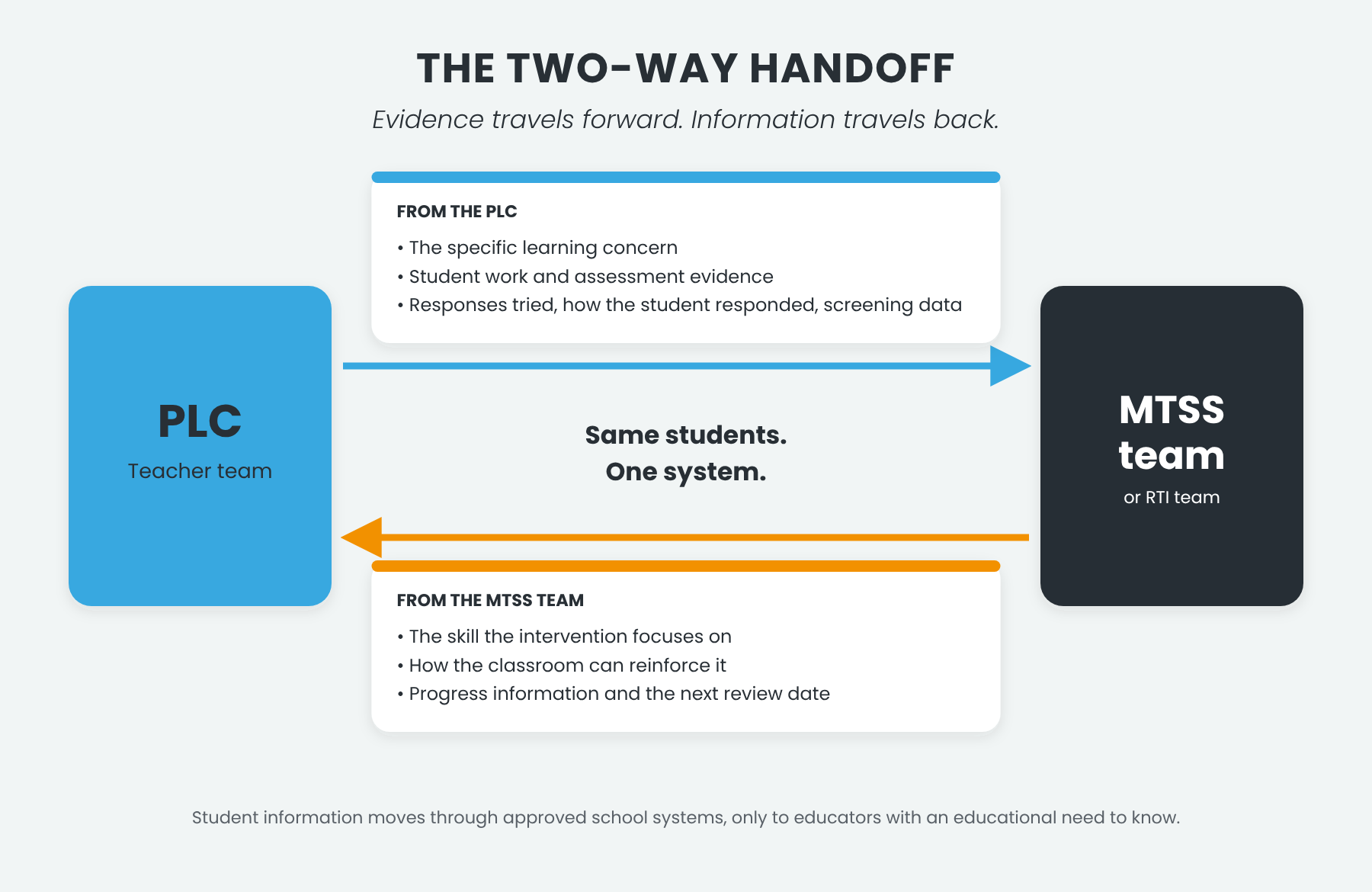
| From the PLC to the MTSS team | From the MTSS team to the PLC |
|---|---|
| The specific learning concern | The skill the intervention is focused on |
| Student work and assessment evidence | How the classroom can reinforce that skill |
| Instructional responses already tried, if any | Meaningful progress information |
| How the student responded | When the team will review progress next |
| Relevant screening information |
Information that only travels one way turns the MTSS team into a destination instead of a partner.
When a student begins intervention, the classroom teachers still see that student every day. They need to know what the student is working on and how to support it in class.
A simple practice helps: when the MTSS team reviews intervention progress, a short summary goes back to the PLC. The PLC then factors that information into its next cycle.
Student information should move through the school's approved systems, and only to educators with an educational need to know.
What This Looks Like in an Elementary School
Consider this illustrative example.
A first-grade PLC reviews a common assessment on reading one-syllable words with short vowels and words with a silent e, such as hop and hope. Teachers also have their fall reading screening results on hand.
In three of the four classrooms, most students are reading silent e words with a short vowel, so hope becomes hop. That is the first question, and the answer is yes: many students, across several classrooms.
So the team starts with core instruction. Teachers compare how they introduced the vowel patterns and agree on a common approach for whole-group lessons over the next two weeks.
The screening data shows that two students were already flagged for significant difficulty with foundational reading skills. The team does not wait. Those concerns go to the MTSS team now, along with the common assessment results.
A smaller group of students across the grade level missed the target in ways that go beyond the shared pattern. The team uses its daily intervention block to give those students targeted reteaching, then reassesses with a short word-reading check.
Most of the group improves. Four students do not.
Their teachers look at the student work more closely. All four also seem to struggle to blend sounds in three-letter words such as sat and pig. That may be a gap below the current target.
The PLC shares the concern with the MTSS team, along with the assessment results, a description of the reteaching, and the reassessment.
The MTSS team reviews the classroom evidence alongside existing screening and assessment results. Using the school's intervention decision rules, it decides what additional assessment or support is appropriate.
The interventionist then shares a brief progress update with the first-grade PLC every few weeks.
Elementary schools often have structures that make this easier: grade-level teams that share students, a common intervention block, and early reading screeners. The risk is different. Groups form, but they rarely change, and the reassessment step gets skipped.
What This Looks Like in a Secondary School
Consider this illustrative example.
An eighth-grade science PLC reviews a common assessment that asks students to read a short passage and write a claim supported by evidence.
Most students write a reasonable claim. A group across all three teachers' classes struggles to support it with evidence from the passage.
That is the second question. The team plans a reteach on using evidence and teaches it inside regular class periods, since the school has no shared intervention block. It reassesses with a shorter task the following week.
Many students improve. Several do not.
As the teachers look at those students' work and think about class discussions, a different pattern appears. Several of these students explain the science clearly when they talk about it. They struggle when they have to read the passage on their own.
The science team does not try to diagnose the cause. It could be word reading, vocabulary, background knowledge, or several of these together.
The team shares its observations and the student work with the MTSS team. Further reading assessment finds significant word-reading difficulties that the science assessment alone could not show.
The MTSS team arranges reading intervention through the master schedule. The science teachers learn what the students are working on and how to support their reading in class while that work continues.
Older students who struggle with reading can have a word-level gap that is easy to miss in content classes. A secondary PLC may be where a concern like that first becomes visible. The PLC's job is to notice it and share the evidence. The MTSS process finds the cause.
Secondary schools face different conditions. Teachers see far more students. PLCs are usually organized by course, and there is often no shared time for reteaching. Data may come mostly from grades and course assessments rather than screeners.
Research reflects these differences. Morningstar, Lombardi, and Test (2018) note that MTSS approaches were initially developed as elementary initiatives and that there is less research at the secondary level. They discuss the challenges of adapting MTSS to secondary schools, including organizational conditions that differ from elementary schools.
Scheduling is one of those conditions. The MTSS Center's brief on RTI scheduling processes for middle school, developed through discussions with middle schools in 28 states, addresses how secondary schools can build a workable schedule for this work.
For secondary leaders, the implication is practical. The handoff has to be designed around the master schedule, not borrowed from an elementary model.
What Leaders Need to Put in Place
Teachers and facilitators cannot build this handoff on their own. It depends on conditions that school and district leaders control. A leadership team that examines PLC implementation is well placed to own these conditions.
A shared definition
Decide what your school means by each tier, and make sure the PLC and the MTSS team use the same language.
Data that arrives in time to use
If common assessment results or screening data arrive weeks after instruction, the reteach-and-reassess loop breaks down.
Time for targeted reteaching
In elementary schools, this is often an intervention block. In secondary schools, it may need to be built into the master schedule or into class periods by design.
A clear referral path
Teachers should know when to raise a concern, what evidence to include, and who receives it. They should also know that they do not need to wait for a reteaching cycle when the evidence already shows a need.
A process, not just a person
An instructional coach, interventionist, or administrator who sits on both teams can help information move. But that person should coordinate an established process, not be the only way information travels. Otherwise the handoff breaks when that person changes roles or leaves.
A return path
Decide how and when intervention progress comes back to the PLC.
The facilitator's responsibility is to guide the PLC's collaborative work. The leadership team's responsibility is to establish the conditions that let the PLC and the MTSS team work as one system.
Questions for Your Leadership Team
Before changing either process, look at how the handoff works now.
- When a PLC identifies a concern, how do teachers decide whether it belongs to core instruction, targeted reteaching, the MTSS team, or more than one?
- What does a referral to the MTSS team include right now? A name, or evidence?
- How do classroom teachers learn what happens once a student is in intervention?
- Do our PLCs and our MTSS team use the same definitions for each tier?
- What would need to change in our schedule for the reteach-and-reassess loop to work?
Start with one question. Look at how two or three PLCs handle it, and include teachers' perspectives before deciding what to change.
If you are not sure where your PLCs are breaking down, the free VOYAGE PLC Health Check can help locate which condition is weak: Structure, Facilitation Skill, Shared Understanding, or Sustained Investment.
Two Teams, One System
A PLC and an MTSS team are not doing the same job twice.
The PLC asks what the evidence says about instruction for everyone, and what the team will reteach.
The MTSS team asks what individual students need beyond what the classroom can provide.
The work between them is the handoff: evidence that travels forward when a student needs more, and information that travels back so teachers can support that student every day.
When the handoff is clear, the PLC stops sorting students and starts improving instruction. And the students who need more support arrive at the MTSS table with the evidence that helps them get it.
How VOYAGE Horizons Supports This Work
The Short Data Cycle is part of the VOYAGE Horizons approach to PLC implementation. It gives teams a routine for moving from formative data to an instructional decision, including the reteach and reassessment steps that produce useful evidence for the handoff.
If you want to train your staff on this routine, Data-Driven Decisions: A Practical Guide Using the Short Data Cycle is a 30-minute professional learning module with videos, a Short Data Cycle guide, and templates.
For schools that want support connecting their PLCs and MTSS process, see consulting services.
Learn more about VOYAGE Horizons or explore additional PLC implementation resources from Juniper Consulting LLC.
Common Questions About PLCs and MTSS
How do PLCs and MTSS work together?
They are two parts of one system, connected by a handoff. The PLC examines learning across its classrooms and decides how its instruction should respond. The school's MTSS process coordinates additional support when a student's needs go beyond what core instruction and classroom reteaching can address. Evidence should travel between them in both directions.
What is the difference between a PLC and an MTSS team?
A PLC is a teacher team that examines student learning to improve instruction for the students it teaches. An MTSS team, often called an RTI (Response to Intervention) team, coordinates additional support for students who need more than core instruction, following the school's procedures. The PLC often notices a concern first. Exact roles vary from school to school.
Is a PLC's reteaching the same as Tier 2?
No. In most MTSS frameworks, Tier 2 means small-group, standardized supplemental intervention. A short reteach planned by a PLC after a common assessment is differentiation within Tier 1. The VOYAGE Horizons Short Data Cycle uses the label "Tier 2 instruction" for that reteaching, but it is a label within the training routine, not the same as Tier 2 supplemental intervention in a district's MTSS framework.
When should a PLC involve the MTSS team?
When the evidence suggests a need beyond what the classroom can address. That evidence can be a pattern, where the same student misses target after target even with reteaching. It can be depth, where the student seems to be missing a skill beneath the current target. Or it can be existing screening or progress-monitoring data. A PLC does not need to complete a reteaching cycle first.
What if many students miss the same skill?
That pattern points to core instruction first. If many students across several classrooms miss the same target, the team should examine how it was taught and what the student work shows before building intervention groups. Adding many names to an intervention list treats a classroom problem as an individual one.
How is MTSS different in secondary schools?
Secondary teachers see more students, PLCs are usually organized by course, and there is often no shared time for reteaching. Research notes that MTSS approaches were initially developed for elementary schools and that adapting them to secondary schools requires attention to different organizational conditions, including scheduling.
References
MTSS Center. (n.d.). Multi-level prevention system. American Institutes for Research. https://mtss4success.org/essential-components/multi-level-prevention-system
MTSS Center. (n.d.). RTI scheduling processes for middle school. American Institutes for Research. https://mtss4success.org/resource/rti-scheduling-processes-middle-school
Morningstar, M. E., Lombardi, A., & Test, D. W. (2018). Including college and career readiness within a multitiered systems of support framework. AERA Open, 4(1). https://doi.org/10.1177/2332858418761880