The meetings are on the calendar. The agenda is followed. Data is discussed. Teams leave with next steps.
And then Monday comes, and instruction looks the same as it did the week before.
This isn't a commitment problem. It's a diagnosis problem.
The first time I led a school-wide PLC rollout, I did everything right on paper. I built the agendas. I matched strategies to the pacing calendar. I facilitated every meeting, guided every discussion, and captured all the notes. And it still didn't work — not because the teachers weren't trying, but because I was solving a problem I hadn't actually diagnosed. I assumed the issue was skill. The real barrier was structural. There was no protected follow-up time, no shared understanding of purpose, and no system connecting our conversations to what happened in classrooms the next day.
I spent a year treating the wrong problem. And I've watched the same pattern repeat in every school I've worked in since.
When a PLC isn't producing results, the response is predictable: adjust the agenda, send facilitators to training, introduce a new protocol. Sometimes that helps. Often it doesn't. Because the wrong problem is being solved.
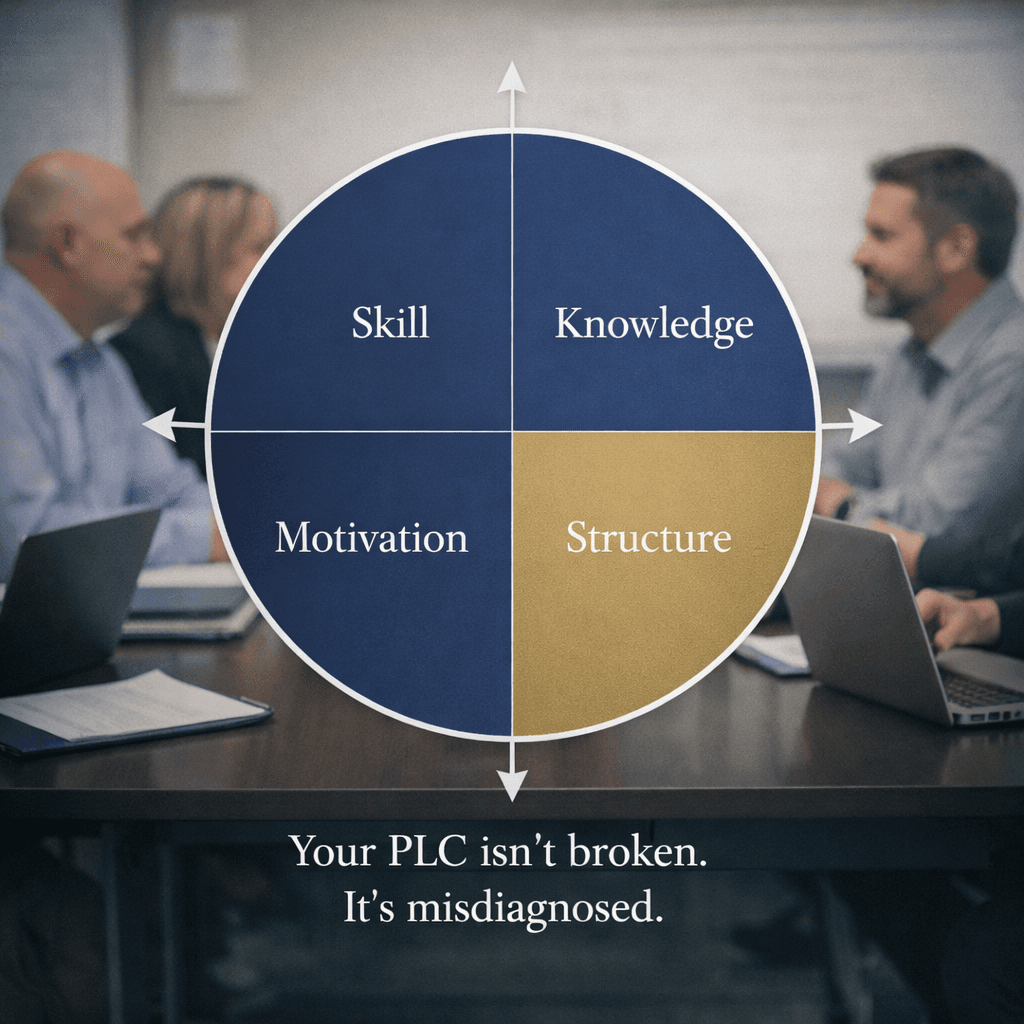
The Four Root Causes of PLC Breakdown
When PLCs stall, the breakdown typically sits in one of four areas. Each requires a different response. Most schools pick one — and it's often not the one they actually need.
Skill Gaps
The people leading PLCs were never trained to facilitate adult learning.
You're seeing this when conversations stay surface-level, even with a solid agenda and the right data in front of the team.
What leaders often assume instead: "We need better protocols."
Protocols can help. But without facilitation skill, they don't change the depth of the conversation.
Knowledge Gaps
Staff don't have a shared understanding of what PLCs are designed to do.
You're seeing this when PLC time is used for planning, task completion, or general collaboration — but not for improving instruction based on evidence of student learning.
What leaders often assume instead: "We need more accountability."
Accountability without clarity creates compliance. It doesn't create meaningful practice.
Motivation Gaps
Educators have experienced too many initiatives that didn't lead to real change.
You're seeing this when engagement is low, participation is passive, and PLC work feels like something to get through rather than something that matters.
What leaders often assume instead: "We need to re-energize staff."
Energy isn't the issue. Belief is. And belief comes from seeing that the work leads somewhere.
Structural or Resource Gaps
The system itself is getting in the way.
You're seeing this when there's no protected time, inconsistent team membership, unclear roles, or no follow-up between meetings.
What leaders often assume instead: "We need better training."
Training will not resolve this. If the structure doesn't support the work, the work won't take hold.
The pattern across all four is consistent: schools try to fix what's visible. The actual issue is often underneath.
What the PLC Health Check Does
The PLC Health Check was built to address that gap.
It's a short diagnostic — about 3 to 5 minutes. You respond to a series of questions about how your PLCs are currently structured, how they're facilitated, how teams engage, and how leadership supports the process.
At the end, you receive a clear breakdown of where your primary gap is — skill, knowledge, motivation, or structure — and where to focus first.
Most PLC surveys measure perception: how people feel about meetings, collaboration, or time use. This tool does something different. It identifies where the system is breaking. It doesn't tell you whether people like PLCs. It tells you whether your current design is capable of producing the outcomes you're expecting.
That distinction matters. Because misdiagnosis leads to misaligned solutions. And misaligned solutions are where time, energy, and trust get lost.
What to Do With Your Results
Once you know where the breakdown is, the next step becomes clearer.
If your primary gap is skill → Build facilitator capacity. Strong agendas won't improve outcomes if the person leading can't move a team from discussion to instructional decision-making. Module 2: The Facilitator is designed for exactly this.
If your primary gap is knowledge → Establish a shared understanding of what PLCs are for. Without it, teams default to what feels most immediately useful — planning, organizing, completing tasks. Module 1: The Source of the Issue supports leadership teams in clarifying purpose and aligning practice.
If your primary gap is motivation → Create visible evidence that PLC work leads to impact. Motivation doesn't increase because expectations are restated. It increases when educators see that what they're doing matters. Module 3: Continuous Improvement builds the short-cycle feedback loops that make progress visible.
If your primary gap is structural → Address the system itself — time, scheduling, team design, role clarity, follow-through. Without these, even strong facilitation and clear purpose won't sustain. This is where direct consulting support is often necessary, because structural challenges require an outside perspective on how the system is currently functioning.
Take the PLC Health Check
Most PLCs don't need more effort. They need alignment between the problem and the response.
Find out what's actually stalling your PLCs. The diagnostic takes less than five minutes and gives you a clear starting point.
→ Take the Free PLC Health Check
Want the full framework? VOYAGE Horizons is a complete PLC professional development system — four self-paced modules that address skill, knowledge, motivation, and structure so your PLCs function as intended. Your team can start this week.
Most PLCs don't fail because people stop trying.
They fail because the system never gets corrected.