
PLC conversations do not always go off track because someone is being difficult. Sometimes they drift because the team started talking about something else that also matters.
You are facilitating your team's PLC.
Ten minutes in, the conversation has moved to next week's field trip. Then the pacing calendar. Then who is making copies.
Everyone is engaged. The questions are real.
But this is not what the time is for.
You also teach next door to these people. You eat lunch with them. You are not their supervisor.
So what do you say?
Most advice about getting a meeting back on track assumes the problem is behavior. Another kind of detour is easier to miss.
The conversation is polite, organized, and on schedule. It has simply moved away from student learning.
That kind of detour needs different words.
In brief
- PLC conversations go off track in two ways. Some detours are about the meeting. Others are about the purpose.
- In a purpose detour, the team has moved into planning, logistics, or problems it cannot change.
- The redirect points back to student evidence and an instructional decision, not to the agenda.
- A detour that returns every week is information for the leadership team.
On this page
- Two kinds of off track
- Three moves that do most of the work
- What to say: meeting detours
- What to say: purpose detours
- Why these sentences are hard to say
- When the same detour keeps coming back
Two Kinds of Off Track
Name the kind of detour before you respond.
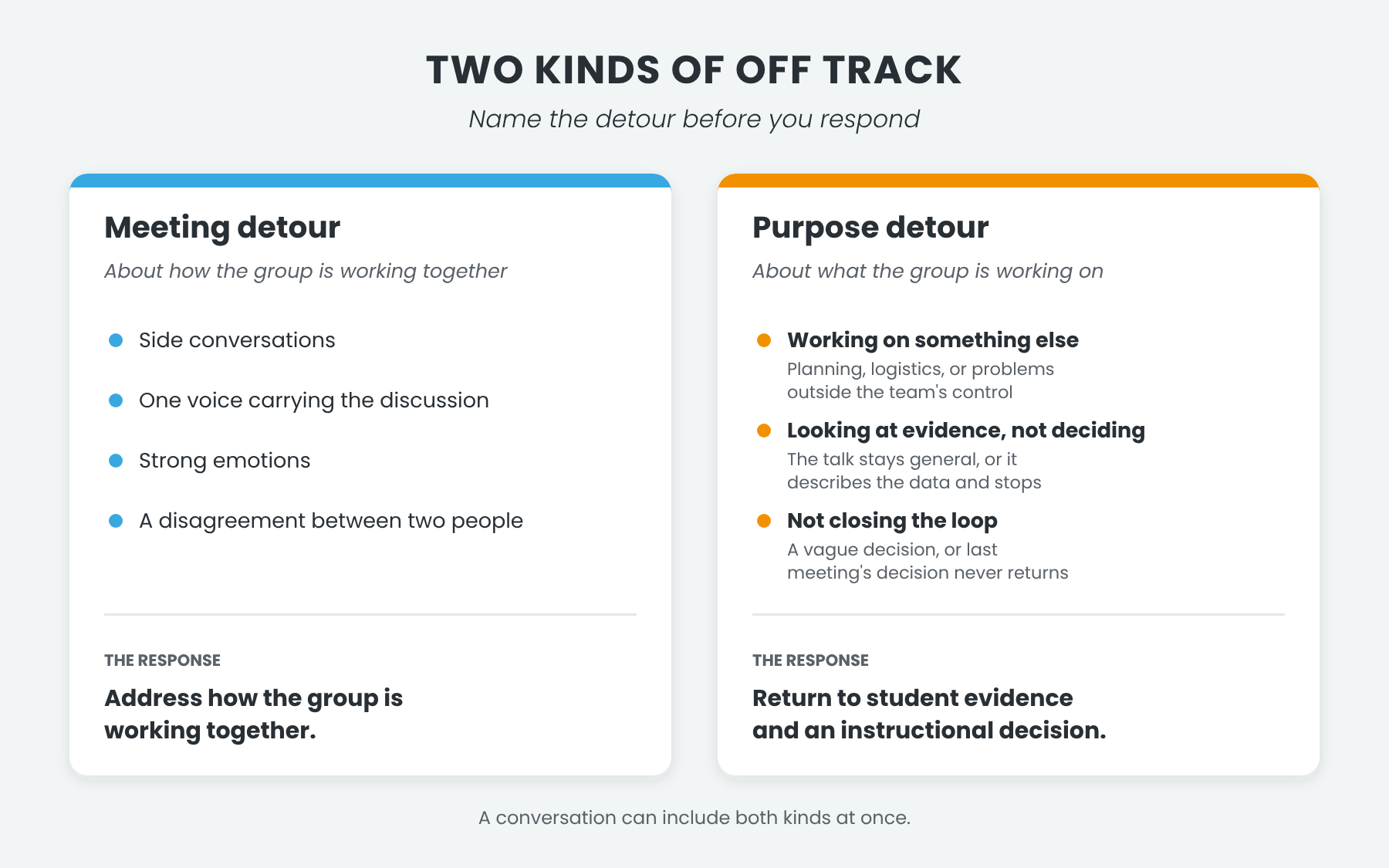
A meeting detour is about how the group is working together. Side conversations. One voice carrying the discussion. Strong emotions. A disagreement between two people.
These happen in any meeting, in any profession.
A purpose detour is about what the group is working on. The meeting is running well. People are listening to each other. The agenda may even be on time.
But the team is no longer examining what students are learning or deciding how instruction should respond.
Purpose detours come in three forms:
- The team is working on something else. Lesson planning, logistics, or problems outside its control.
- The team is looking at evidence but not deciding. The talk stays general, or it describes the data and stops.
- The team has not closed the loop. A decision is vague, or last meeting's decision never comes back up.
None of these mean the team is doing something wrong. Planning and logistics are real work.
The difference is whether the team is planning together or learning together. Both cannot fill the same forty minutes.
A conversation can involve both kinds of detour at once. The two categories are a way to choose a response, not a formal classification.
Three Moves That Do Most of the Work
The VOYAGE Horizons module The Facilitator teaches three strategies for guiding a discussion back on track. Almost every sentence in this article is a version of one of them.
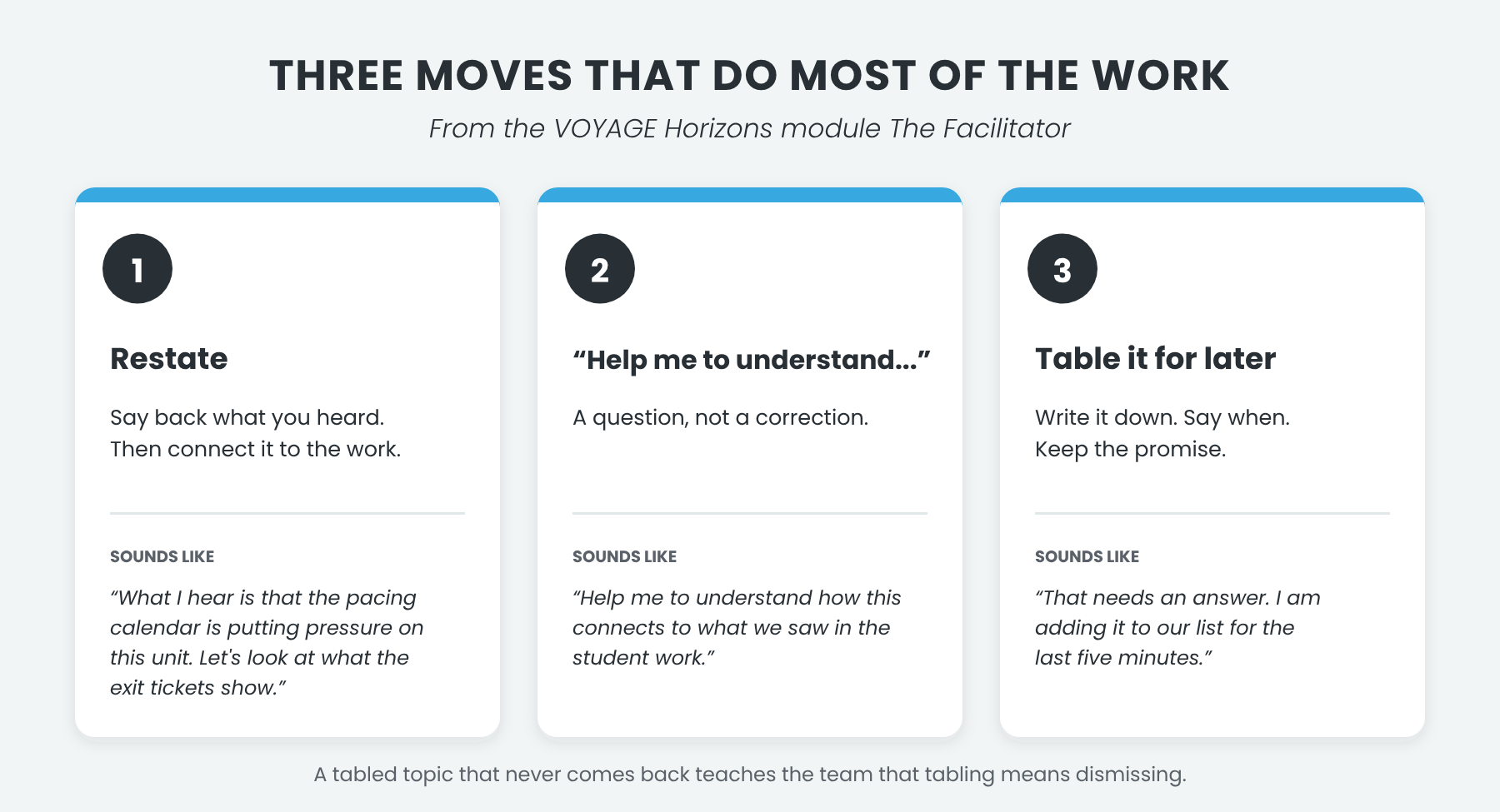
1. Restate
Say back what you heard. Then connect it to the work.
Restating shows your colleague you were listening. It also gives you a natural place to turn the conversation.
"What I hear is that the pacing calendar is putting pressure on this unit. Let's look at what the exit tickets show so we know where that time needs to go."
2. "Help me to understand..."
This is a question, not a correction.
It asks a colleague to connect what they are saying to the evidence or the goal. Sometimes the connection is there and the team needed to hear it. Sometimes the question alone brings the conversation back.
"Help me to understand how this connects to what we saw in the student work."
3. Table the Discussion for Later
Some topics matter and do not belong in this meeting.
Write the topic where everyone can see it. Say when it will be addressed. Then keep that promise.
"That needs an answer. I am adding it to our list for the last five minutes."
A topic that is tabled and never revisited teaches the team that tabling means dismissing.
What to Say When the Detour Is About the Meeting
These are the situations most facilitators expect. The Facilitator module addresses each one.
| What is happening | What you can say |
|---|---|
| Two people are having a side conversation. | "It sounds like there is something useful in that conversation. Can you share it with the whole group so we are all on the same page?" |
| One person is doing most of the talking. | "We've heard one perspective. I'd like to make space for other thinking. What are others noticing in the student work?" |
| A colleague's ideas are being passed over. | "I've noticed [name] has been sharing some ideas. I'd like to understand more about your perspective on [specific topic]." |
| Emotions are running high. | "This is frustrating, and that makes sense. Let's come back to what we agreed we are here to do." |
| Two members disagree. | "We're hearing two different interpretations. What evidence supports each one?" |
Two notes on using these.
With strong emotions, validate the feeling without taking sides.
With conflict, not every disagreement can be settled in a team meeting. If it stays unresolved, recommend that the people involved talk privately.
What to Say When the Detour Is About the Purpose
This is the harder kind, because nothing looks wrong.
The redirect does not point back to the agenda. It points back to two things:
- evidence of student learning
- an instructional decision
When the team is working on something else
| What is happening | What you can say |
|---|---|
| The team has moved into lesson planning. | "This planning matters, and we need time for it. Before we plan what comes next, what did the student work tell us about what we just taught?" |
| Announcements and logistics have filled the time. | "These need answers. I am writing them down for the last five minutes so we protect the time for student work." |
| The conversation keeps returning to things the team cannot change. | "That is real, and we cannot change it from this table. What part of this is within our control, and what decision can we make as a team?" |
When the team is looking at evidence but not deciding
| What is happening | What you can say |
|---|---|
| The team is talking about students in general. | "Help me to understand what we are seeing in the work that tells us that. Which responses show it?" |
| The team is describing the data and stopping there. | "Given the data and feedback we've discussed, what do you all believe should be our next course of action?" |
| The team has named the need but not the response. | "We know what students are struggling with. What instructional response can we agree to try, and what evidence will we bring back?" |
When the team has not closed the loop
| What is happening | What you can say |
|---|---|
| A decision was made, but it is vague. | "Let me restate what I heard. We will [action] by [date], and we will bring [evidence] to our next meeting. Did I get that right?" |
| Last meeting's decision has not come back up. | "Before we start something new, what happened when we tried what we agreed on? What did students do?" |
What these sentences have in common
Each one begins by treating the detour as reasonable.
Each one ends with a question about student learning or a next step.
None of them tell a colleague they are wrong.
What this can look like
Consider this illustrative example.
A third-grade team is reviewing a common assessment on two-step word problems. Many students solved the first step and stopped.
Within a few minutes, the conversation has moved to the pacing calendar. There is not enough time in the unit for problem solving. Everyone agrees. The discussion picks up energy.
The concern is real. It is also not something the team can change from the table.
The facilitator restates, then redirects:
"What I hear is that the pacing calendar does not leave enough room for problem solving. I am writing that down, because it needs to go to our leadership team. For the time we do have this week, what does the student work tell us students need?"
The team goes back to the papers.
They notice that most students who stopped early answered a question the problem did not ask. The team agrees to have students restate the question in their own words before solving. Each teacher will bring three student samples to the next meeting.
Two things happened.
The team made an instructional decision based on evidence. And the pacing concern did not disappear. It went to the people who can act on it.
Research points in the same direction. Horn and Little (2010) examined how two teacher work groups in the same school talked about problems of practice. The conversational routines each group used shaped its opportunities to learn from those problems. The groups differed in how well their talk connected ideas about teaching to specific examples from classrooms.
For facilitators, the principle is this: how a team responds to a problem matters, not only whether the problem was discussed.
Sometimes the difference begins with what the facilitator asks next.
Why These Sentences Are Hard to Say
Knowing the words is one part. Saying them to a colleague is another.
Leading peers is a different skill from leading a classroom. Facilitators guide people who have the same role, the same title, and sometimes more experience.
Three things make the redirect easier.
1. Agree on the purpose before you need to defend it.
A team that has said out loud what PLC time is for has given the facilitator something to point to. The redirect becomes a reminder of the team's own agreement.
2. Make redirecting part of the job the team gave you.
Set clear guidelines at the start. When the norms include "the facilitator will bring us back when we drift," a redirect is the facilitator doing what the team asked.
Norms are what make this possible. The Facilitator module names upholding the team's norms as one of the facilitator's core responsibilities, and it builds a review of the norms into the start of each meeting.
Norms work best when the team writes them together and revisits them when they stop working. A few that make redirecting easier:
- We keep student work at the center of our discussion.
- We end each meeting with a decision and a next step.
- Topics outside our purpose go on the list for later.
- Anyone can ask, "How does this connect to the student work?"
The last one points toward the goal of this article. When anyone on the team can ask that question, redirecting stops being the facilitator's job alone.
Norms deserve a closer look of their own, and I will write about them in a future article.
3. Use the agenda and the clock as partners.
Reference the agenda when you steer the conversation back. Appoint a timekeeper. Summarize the discussion periodically so the group can see where it is.
These structures do not replace the skill. They make it safer to use.
When the Same Detour Keeps Coming Back
One detour is a moment. The same detour every week is a pattern.
A recurring pattern may tell you something about the conditions surrounding the team, not only the people in the room.
- If logistics fill the meeting every week, the team may have no other place to handle them.
- If the team never reaches a decision, the evidence may be arriving too late to use.
- If planning takes over, the team may not have enough planning time anywhere else in the schedule.
These are conditions. A facilitator cannot fix them with a better sentence.
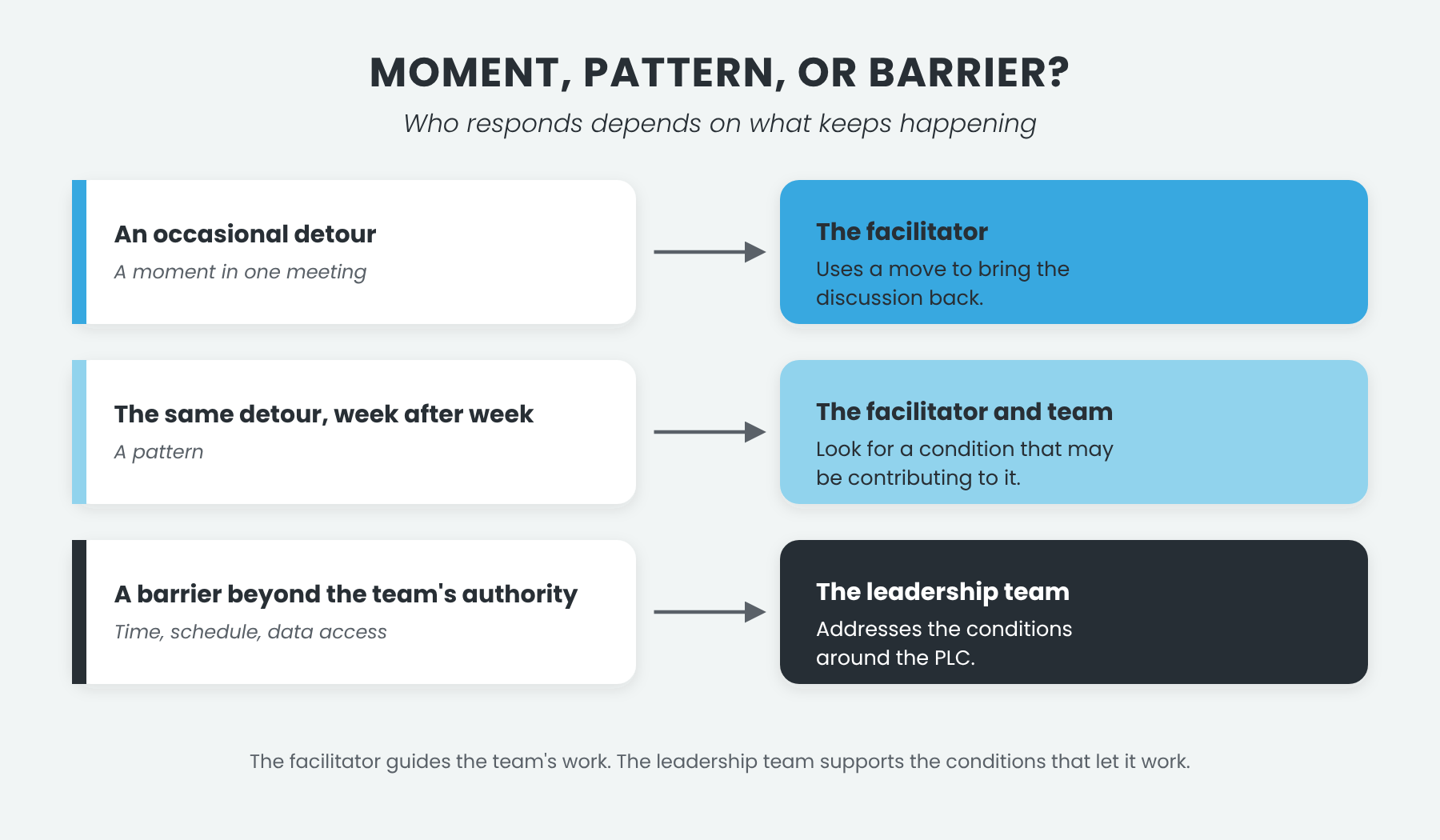
A simple way to decide what to do:
- An occasional detour. Use a facilitation move to bring the discussion back.
- The same detour, week after week. Look for a condition that may be contributing to it.
- A barrier the team cannot resolve within its authority. Bring it to the leadership team.
The facilitator's responsibility is to guide the team's collaborative work. The leadership team's responsibility is to establish and support the conditions that allow that work to be effective.
When a detour keeps returning, name the pattern and bring it to your leadership team.
The VOYAGE PLC Health Check can help a school locate which condition is weak: Structure, Facilitation Skill, Shared Understanding, or Sustained Investment.
Raising the pattern is not a failure of facilitation. It is part of what facilitators need from leadership.
Sometimes the answer is not a better sentence
Years ago, I facilitated a third-grade team where one veteran teacher regularly pulled our discussions toward her frustrations. The more I redirected, the more firmly she held her ground. I tried every facilitation move I knew.
The answer came from somewhere unexpected. One weekend, I watched my sister let my five-year-old niece say everything she needed to say. She did not redirect her. She listened. I realized I had been trying to manage the team's frustration instead of acknowledging it.
I was at my wit's end, and this was my Hail Mary. At our next meeting, I opened with five minutes for venting. No interruptions. No fixing. I set a timer.
My administration questioned the move, given the strong personalities on the team. It looked like a sure way to lose the meeting. It did the opposite. When the timer went off, she was ready to work, and she was collaborative and, dare I say it, enjoyable. Others began to speak up during those five minutes too. The collaboration that followed went deeper than anything we had before.
The detour was a pattern, and patterns usually need a change to the structure, not a better redirect. This team needed a set place for frustration to be heard, with a clear beginning and a clear end.
I wrote the full story in From Scripted to Supported.
After the Meeting
Redirecting is a skill. It improves with reflection.
The Facilitator module gives facilitators four questions to ask themselves:
- What went well and not so well in facilitating the discussion?
- Did I help create an inclusive environment where everyone participated?
- Were the team's needs and objectives kept at the center?
- What could I do differently to be a more effective facilitator?
Add one more for purpose detours:
- At what point did the conversation move away from student learning, and what did I say?
You do not need to catch every detour. Notice one. Choose one sentence to try next time.
The Words Are a Starting Point
No list of sentence frames can run a PLC.
What the frames give a facilitator is a first sentence. One that respects a colleague and still protects the purpose of the time.
Over time, the exact words matter less. The team begins to redirect itself. Someone other than the facilitator asks, "What does the student work show?"
That is the goal.
Not a facilitator who controls the conversation. A team that knows what the conversation is for.
How VOYAGE Horizons Supports This Work
The Facilitator is the VOYAGE Horizons module that prepares teacher leaders to guide PLC work. It covers structuring meetings, using data, guiding discussions back on track, and building a collaborative team culture.
Learn more about VOYAGE Horizons or explore additional PLC implementation resources from Juniper Consulting LLC.
Common Questions About Redirecting a PLC Conversation
What should a PLC facilitator say when the conversation goes off track?
Begin by treating the detour as reasonable. Then ask a question that returns the team to student learning or a next step. For example: "This planning matters, and we need time for it. Before we plan what comes next, what did the student work tell us about what we just taught?"
What are the most common ways a PLC conversation goes off track?
There are two kinds. A meeting detour is about how the group is working together: side conversations, one voice carrying the discussion, strong emotions, or conflict. A purpose detour is about what the group is working on: the team has moved into lesson planning, logistics, or problems it cannot change, or it is looking at evidence without making a decision.
How do you redirect colleagues without damaging trust?
Agree on the purpose of PLC time before you need to defend it. Make redirecting part of the job the team gave the facilitator by including it in the norms. Use sentences that acknowledge the colleague first and end with a question.
What are three strategies for guiding a PLC discussion back on track?
Restate what you heard and connect it to the work. Ask "Help me to understand..." so a colleague can connect the comment to the evidence or the goal. Table the discussion for later by writing the topic down, saying when it will be addressed, and keeping that promise.
What should a facilitator do when a PLC team looks at data but never makes a decision?
Ask for the decision directly: "Given the data and feedback we've discussed, what do you all believe should be our next course of action?" Then restate the decision with an action, a date, and the evidence the team will bring to the next meeting.
What if the same detour happens in every PLC meeting?
A detour that returns every week is a pattern. A recurring pattern may tell you something about the conditions surrounding the team, not only the people in the room. The team may have no other place for logistics, or the evidence may arrive too late to use. Name the pattern and bring it to the leadership team, which is responsible for the conditions surrounding PLC work.
References
Horn, I. S., & Little, J. W. (2010). Attending to problems of practice: Routines and resources for professional learning in teachers' workplace interactions. American Educational Research Journal, 47(1), 181-217. https://doi.org/10.3102/0002831209345158